EXPLAINED: Labour's schedule to shift Starmer from office
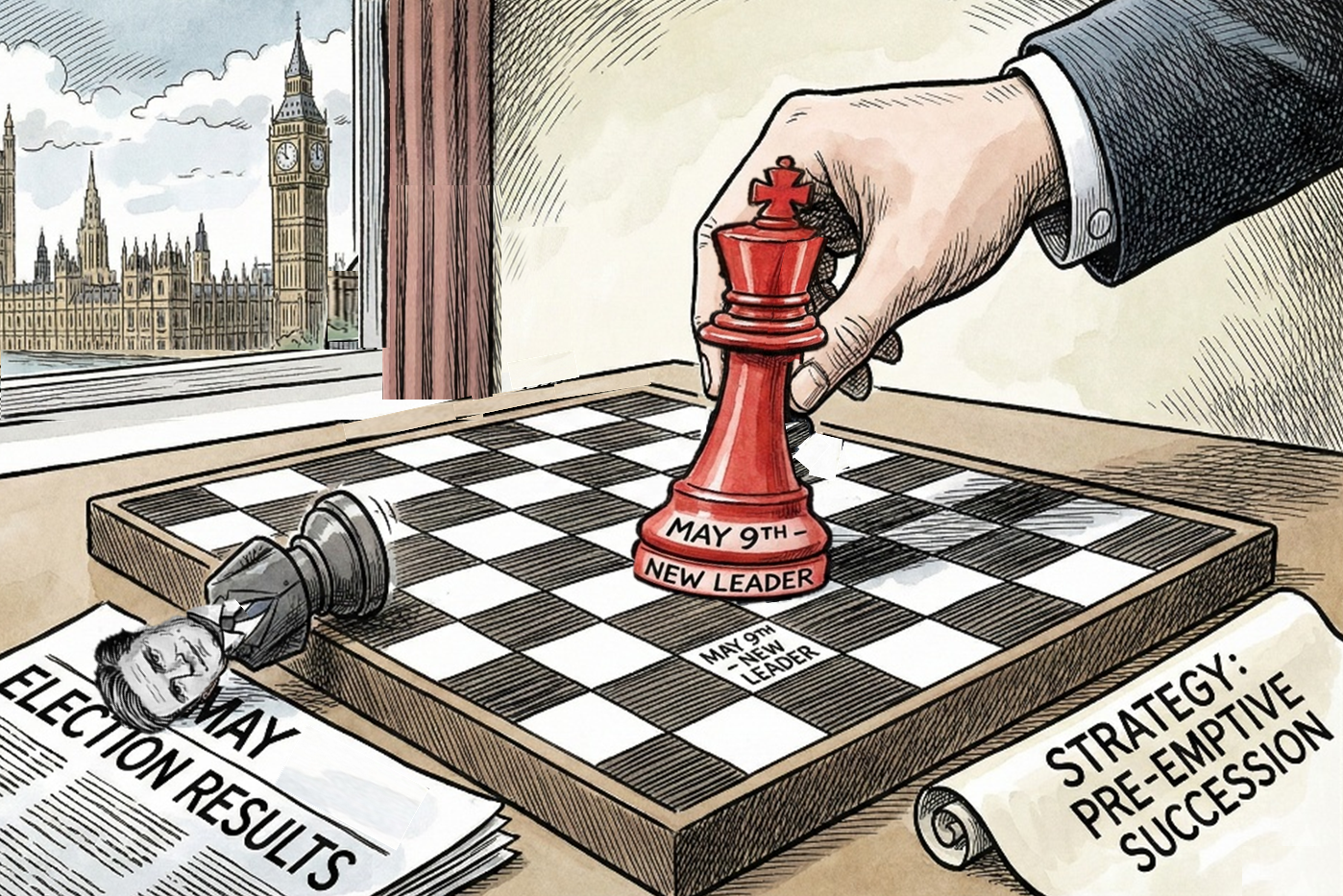
Why Labour should announce its new leader on May 9th 2026

Labour is not only in a terrible mess of its own making but it is also caught on the horns of an apparent dilemma.
Everyone knows that Starmer is going to have to leave Downing Street before very long – the only questions are exactly how and precisely when. Virtually no one expects him to last the year (I consider the odds of 1/3 that he is ousted in 2026 to be very attractive). He may even be gone in days. Today’s departure of Morgan McSweeney is as likely to hasten Starmer’s departure as it is to delay it.
It is true that the two main contenders - Rayner and Streeting – face their own timing problems. Outrageously, HMRC have still not pronounced on Angela Rayner’s tax case after six months of mulling it over – a matter that should take no more than six days, perhaps even just six hours, to resolve if we had an even half-competent tax office.
This means the current favourite is hamstrung by a useless bureaucracy refusing to give her a straight answer. However furious you might be about her failure to pay stamp duty, she surely has a right to know by now where she stands. Her putative candidacy could be derailed at any moment by HMRC declaring she owes huge fines for egregiously dodging her dues. If that is their judgment, she deserves to hear it now.
Meanwhile, Streeting will be going through all of his social media feeds desperately deleting any photos of – or positive references to – Peter Mandelson. This could take some considerable time. His partner has already cunningly airbrushed out of his CV any reference to having worked for the Prince of Darkness.
Andy Burnham would be the nailed-on favourite to replace Starmer but for the fatal flaw of not being a Member of Parliament. That is not something he can fix anytime soon.
All of these considerations might incline these three individuals – and their supporters – to hang back and wait.
That calculation is seemingly, but foolishly, given more weight by an electoral judgment which seems to be permeating a lot of private discussions within the Labour Party and across the wider media. The argument goes that the upcoming by-election later this month and the local, Scottish and Welsh elections in May are likely to be so apocalyptic for the government that they would immediately kill stone dead any hoped-for honeymoon for a new Labour leader. But I think this line of reasoning is seriously wrong headed.
It seems incredibly unlikely that Downing Street will have a new occupant by February 26th, even if Starmer has announced his intention to resign by then. So, the blame for the catastrophe that is about to engulf Labour in the Manchester by-election (probably coming a poor third behind the Greens and Reform in a once rock-solid safe seat) easily can be pinned on the current administration.
However, there is no good reason for pretenders to the throne to then wait until Labour is eviscerated across local authorities and in Scotland and Wales before forcing Starmer out of No 10.
There is, of course, a very fair chance that the prime minister will choose to fall on his sword in the next week or so – either because he finally realises his position is untenable or because further embarrassing revelations about the Mandelson scandal finally force that penny to drop.
If, however, he insists on limping on, humiliated and bleeding, for a couple more weeks, the rebels should wait until the Gorton & Denton result comes in, but not much longer than that.
Assuming the result is bad for Labour (and it’s likely to be dreadful), this provides the obvious grounds for triggering a leadership election. One presumes that some sort of residual level of sanity survives in Keir Starmer’s brain and he would choose not to contest it.
Either way, it takes around a couple of months to complete a leadership contest and the timetable is in the hands of Labour’s National Executive Committee and they can set the schedule to suit their own partisan interests.
It would be reasonable for them to determine that the ballot would close on Friday May 8th and to announce the winner on Saturday May 9th. Whoever triumphs would then become prime minister on Monday May 11th.
This would have echoes of Theresa May’s or Boris Johnson’s departure from the highest political office in the land. May declared her intention to step aside on May 24th 2019. She continued as a lame duck PM for exactly two months until Boris beat Jeremy Hunt in the ensuing leadership contest and entered Downing Street on July 24th. Similarly, the gap between Boris resigning in 2022 and him being replaced as prime minister by Liz Truss, after she defeated Rishi Sunak, was also a couple of months.
In my scenario, Starmer is forced to resign no later than in the week beginning March 2nd. The Labour NEC determine – in their infinite wisdom - that the final day for party members to cast their ballot papers will be May 8th, the day after the local, Scottish and Welsh elections. If Starmer decides to resign earlier, the NEC should also consider stretching the leadership contest by a few weeks to only conclude in the immediate aftermath of May’s elections.
This brings a wide range of benefits to Labour.
First, taking the blame for the awful results in May will essentially be Starmer’s last act as party leader. There is no new prime minister yet in place to take the rap.
Second, the news coverage around Labour’s electoral evisceration will be diluted – perhaps even largely displaced – by the conclusion of the party ballot and the announcement of a new leader and PM who can begin by saying that they have heard the opinion of the electorate and promise a brave new dawn. The piecing together of a new Cabinet will also attract considerable media interest again overshadowing a full postmortem of the (disastrous) May election results.
Third, the contest would distract from campaigning efforts in the May elections. That might sound like a bad thing, but it isn’t. I am hearing that the doorstep reaction greeting Labour campaigners is so horrifically hostile that it is further crushing activist morale, which is already on the floor or in the basement. Canvassing and leafletting is doing virtually nothing to improve Labour’s electoral standing at present, but a full-blown contest to choose the next PM (the first time the Labour grassroots would ever have taken such a decision) could energise and enthuse their (admittedly much reduced) membership base.
Fourth, knowing that Starmer is definitely leaving might just help the Labour Party by a smidgen in the polls. I don’t expect it to make much of a difference, but it could be worth something at the margins. Voters who currently wish to send a message that they want Starmer out will have less of an incentive to vent their fury by means of casting an anti-Labour ballot on May 7th. They can be assured that he is going anyway.
Overall, if I were a Labour supporter (a difficult act of empathy for me to engage in, to be honest), the above is an indication of the chain of events I would seek to put in motion. It would, of course, require the leadership election to be contested (otherwise, as in the case of May replacing Cameron, the new PM will be in post too early and will have to take the May 7th hit on their own shoulders) – but that should not require too much in the way of organising, it’s very likely to happen in any event.
However, it may now be the case that the scale of chaos and confusion now gripping Labour is so great that we are in a situation in which whatever happens next will be the result of accident and mishap rather than any form of intelligent design.
Great analysis Mark as always and I think you have it nailed on in terms of how events will unfold.
Ive got my popcorn ready!
Mark - there's a typo in your blog about when Theresa May decided to stand down. It was in 2019, not 2017. Is there a thing called retrospective wishful thinking?